
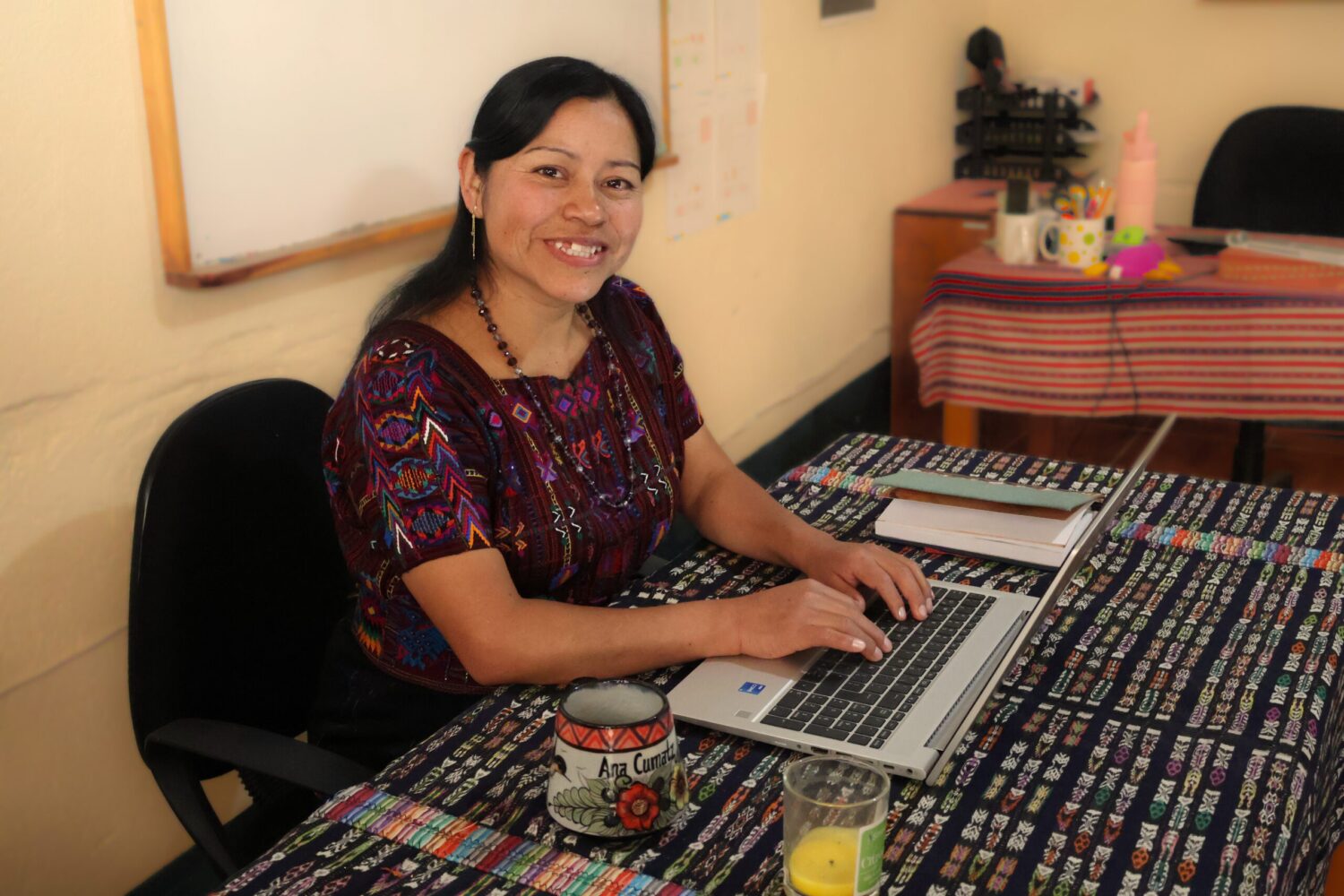
One year ago, Ana Cumatz joined Natün with great enthusiasm and commitment. As a Maya Kaqchikel woman and a leader within a new shared leadership model, Ana reflects on learning, community work, and the importance of cultural relevance as the foundation of sustainable and just processes.
Note: Ana’s reflections were originally shared in Spanish. This translation aims to preserve her voice and meaning as closely as possible.
How do you remember your arrival at Natün one year ago?
I remember my arrival at Natün as a moment of great excitement and commitment. I arrived with enthusiasm, with the deep desire to contribute from my identity as a Maya Kaqchikel woman and with the conviction that community work, when done with respect and cultural relevance, can generate real changes. It was also a challenging and very meaningful beginning, since Natün created for the first time the position of Co-Executive Director of Programs, led by an Indigenous woman, within a new shared leadership model and in an organization in a process of innovation and growth.
What motivated you to join the organization and what expectations did you have when starting this path?
I was motivated by Natün’s mission and its work with communities in the department of Sololá, my territory with which I have a close and meaningful connection. I had the expectation of contributing to community strengthening from the perspective of Indigenous women, from collective leadership, learning from other perspectives, and contributing so that the organization could continue growing with an intercultural and community-based approach.
If you had to describe this first year in one word, what would it be and why?
Learning. Because it has been a year of learning constantly: about shared leadership, about teamwork, about deep listening, and about how to accompany community processes with respect and humility.
What have been the main learnings you take from this first year at Natün?
I have learned that leadership is not exercised through imposition, but through dialogue and collective construction. I have also reaffirmed the importance of trust, honest communication, and the recognition of local knowledge as the foundation for any process of community ethnodevelopment.
Was there a key moment that shaped the way you see your role or your leadership?
Yes, there were moments when I had to stop and listen more, both to my co-director colleague [Elena Wason], as well as to the team, the board, and the communities. Those moments helped me understand that my role is not to direct from above, but to accompany, facilitate, and open spaces so that other voices lead and so that each person on my team can flourish.
How do you feel your way of working and leading has evolved since you arrived?
Since I arrived at Natün I have strengthened my way of working and leading. Today I know my team better, the reality of the communities, and the institutional dynamics, which allows me to have a clearer vision of the direction of the organization and define more coherent strategies. I have gained greater confidence and clarity in my role as co-executive director of programs.
All of this is sustained by honest and constant communication with my co-director colleague [Elena Wason], key for co-leadership.
How do you define your leadership style within Natün?
I define it as community, collaborative, and facilitative leadership. I seek to listen, trust, and accompany the programs, creating conditions for people and teams to flourish, while at the same time balancing institutional responsibility with respect for the processes, times, and ways of the communities.
What has been the most challenging part of leading in a community and intercultural context?
One of the greatest challenges has been harmonizing institutional dynamics with community rhythms, as well as managing diverse expectations. It has also been a challenge to sustain intercultural dialogue constantly and consciously.
What do you value most about the work with your team and with the communities?
I deeply value trust, openness, support, and mutual learning. Working with communities constantly reminds me of the value of collective knowledge and the importance of walking alongside communities.
What does cultural relevance mean to you in Natün’s work?
For me, cultural relevance means recognizing, valuing, and starting from the identities, knowledge, languages, and forms of organization of the Maya communities with which we work, such as Kaqchikel, Tz’utujil, and K’iche’. It is working from their reality and their worldview, understanding that there is not only one way to see and live the world, and that development processes must be built from the communities.
How do you integrate cultural relevance into your decisions and daily leadership?
I integrate cultural relevance by always thinking about how each decision can affect or transform the lives of the people and communities with which we work. This implies listening to and consulting communities, reflecting before deciding, and creating spaces where their voices are protagonists. It also means taking into account and practicing the use of local languages, respecting and strengthening their forms of organization, and recognizing their own ways of understanding the world.
For me, cultural relevance is not only respect, but coherence between what we say and what we do in daily leadership.
Can you share a concrete example where cultural relevance was key to the success of a process or project?
A very significant example was the process of developing Natün’s new strategic plan. This process was carried out in a participatory way, consulting directly with communities and community leaders in their own language and using methodologies that facilitated dialogue from their forms of organization and their way of understanding the world.
Communities were not only listened to, but their voices, decisions, needs, and strengths were taken into account to define the new strategic approaches. This made it possible to build a plan with identity, legitimacy, and community meaning, strengthening trust and active participation of communities in the direction of the organization.
What have you learned from communities about ancestral knowledge and local leadership?
I have learned that ancestral knowledge is a living source of wisdom and that local leadership is based on service, respect, collective responsibility, and the search for the common good—for buen vivir, living well in harmony with community, culture, and territory.
What achievement from this first year are you most proud of?
I feel deeply satisfied to have contributed to the construction of a strategic plan with identity and community meaning, developed in a participatory way and from the voice of the communities. Seeing how their needs, strengths, and dreams were reflected in the direction of the organization is one of the achievements that fills me the most and reaffirms my commitment to this work.
How do you feel your work contributes to Natün’s broader impact?
I believe my work contributes to consolidating an organization that is closer to communities, more aware of its intercultural identity, and more committed to an integral and sustainable ethnodevelopment.
What inspires you to continue working for ethnodevelopment?
Women, women leaders and community leadership, the resistance of peoples, and the hope of building a more just future for new generations inspire me.
What do you dream or hope for your second year at Natün?
I dream of continuing to strengthen community processes, consolidating teamwork, and deepening the cultural relevance approach at all levels of the organization.
What would you like to continue strengthening personally and professionally?
I would like to continue strengthening my skills in collective leadership, intercultural communication, and strategic management, without losing the connection with my roots and values.
What would you like others to understand about working with communities and the importance of cultural relevance?
That working with communities requires time, respect, and humility, and that cultural relevance is not a complement, but the foundation for achieving sustainable and just processes.
